The Flair
of the Grand Masquerade Ball 2027
Ball in the Style of the Rococo
I. The Crowning Glory:
The Grand Rococo Masquerade Ball
II. Splendor and Power:
The Festivities at the Courts of the Prince-Bishops
III. Ball and Game:
The Legacy of the Sun King
IV. A Dance in the Heavens:
The Chambers of the Residence
V. The Dances around 1750
I. The Crowning Glory:
The Grand Rococo Masquerade Ball
As at all the courts of Europe, festivities and balls were far more than mere amusement – they were the most virtuosic instrument of politics and prince-episcopal self-representation. Where, then, could our Grand Masquerade Ball be celebrated more perfectly than amidst the magnificent Baroque splendor of Eichstätt?
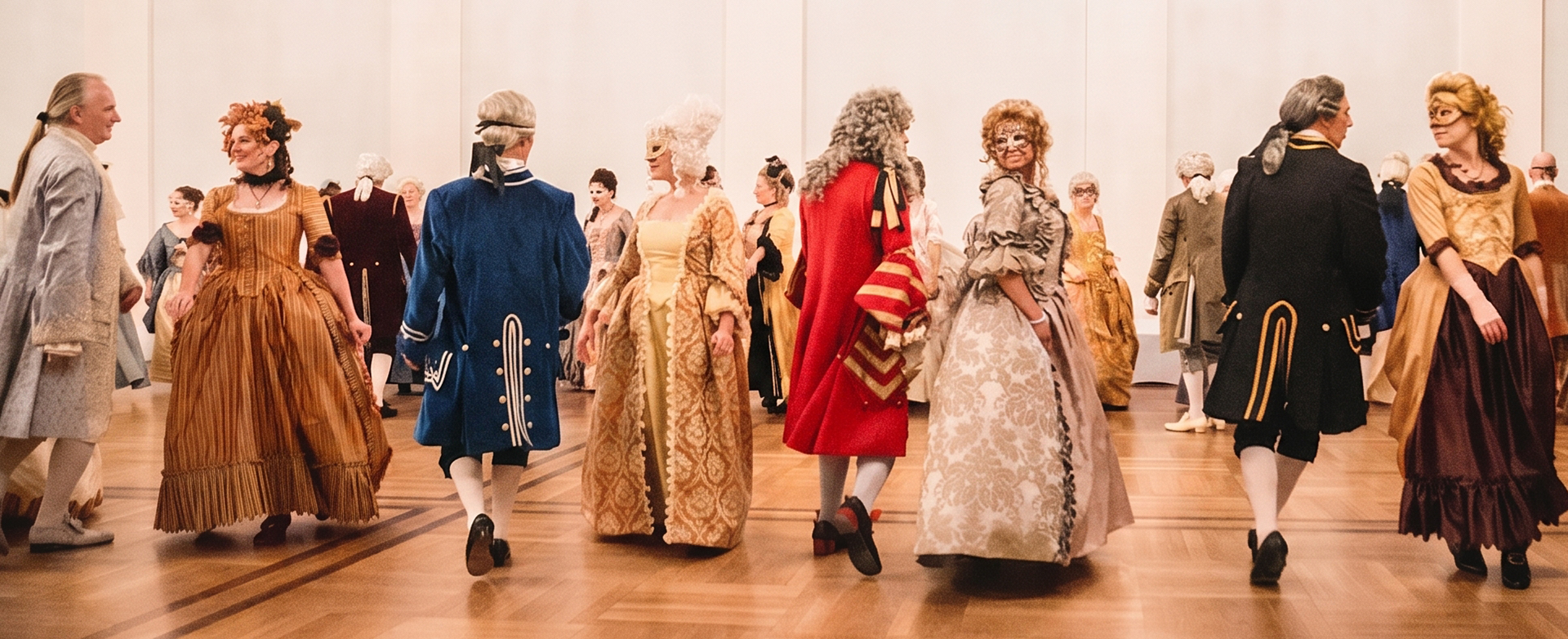
Step through the grand portal at the Residenzplatz and allow yourself to be transported to an era of consummate gallantry upon your very arrival. With a festive entrance into the Hall of Mirrors and a communal toast to our distinguished assembly, we shall commence an evening replete with etiquette, charm, and delight. To the spirited melodies of our orchestra, we shall revive the myriad dances of the epoch.
Immerse yourself in the Venice of the eighteenth century, which – interrupted only briefly by Lent – surrendered itself to a veritable intoxication of festivities. Become gods, nymphs, and fauns for a single night. Dionysus himself invites you to dance! Entirely in the spirit of historical edicts, absolute equality prevails at our Carnevale: by margravial decree, all estates are to behave upon the parquet with such equality that, beneath the mask, no distinction of class or rank remains. Whether in formal attire or costumed – we celebrate and dance as a united, joyous society. Surrender yourself to this lavish attitude towards life. For what is more enticing and mysterious than the profound gleam of two eyes behind a Venetian mask?
II. Splendor and Power:
The Festivities at the Courts of the Prince-Bishops
A celebration at an ecclesiastical court was in no way inferior to the revelry of secular sovereigns. For a prince-bishop, the ballroom was the stage of his power. Through displays of splendor, exquisite music, and luxurious hospitality, one demonstrated wealth, impeccable taste, and political influence. We shall revive this fine art of representation for this one night. An essential element of this princely hospitality is our Grand Souper, presented as an elegant buffet volant. In accordance with courtly custom, it fortifies us with delicate delicacies without interrupting the spirited, exhilarating flow of our night of dancing.
III. Ball and Game:
The Legacy of the Sun King
Since the resplendent days of Louis XIV, it was known throughout Europe: a true ball in the French style consists not solely of choreographed grace, but imperatively requires a thrill of excitement. The game of chance and favor was as much a part of good breeding as the minuet. Therefore, we invite you to tempt fate in our historical casino. Cast the dice, risk a hand at the card table, and allow yourself to be seduced by the allure of winning! Fortuna rewards the bold: depending on the size of our celebrating assembly, highly coveted prizes await, such as complimentary tickets for upcoming balls or our future dance courses. Who knows, perhaps fortune will favor you this evening in more than just love?
IV. A Dance in the Heavens:
The Chambers of the Residence
It is a rare and inestimable privilege not merely to view these historical chambers, but to be permitted to fill them with music, laughter, and dance. Each room of this residence is a masterpiece in its own right, inviting us to become a part of its history.
The very ascent to the piano nobile via the masterful staircase is an experience in itself. This magnificent architecture resembles a veritable ascension to the heavens, preparing our senses for the splendor of the impending night. Upon reaching the summit, the Hall of Mirrors receives us—that absolute jewel of the Rococo, which forms the shimmering heart of our ball night. When the warm candlelight refracts in the countless mirrors, the fine fabrics rustle, and the orchestra begins to play, space and time meld into a moment of perfection.
In order to capture these fleeting moments, we shall furthermore open the doors to the Tapestry Room. Within this chamber of true significance, which quite rightly enjoys the status of a World Heritage Site, we have most discreetly placed our photo booth for your convenience. Here, you may immortalize your masterful appearance against a priceless historical backdrop for all eternity.
V. The Dances around 1750
Authentic records of ball programs from that era are exceedingly rare; we generally know them only from the dance cards of the nineteenth century. Our selection for the ball is therefore a carefully calculated composition: we unite the choreographies of German dance masters with French contredanses—after all, France, even under Louis XV, significantly dictated the style of the European courts. To maintain a program that is sophisticated yet accessible to everyone, we round it off with several lighthearted English country dances.