
The Flair of the Workshop
Learning and understanding the dances of the Rococo
I. Invitation to a Week of Gallant Dance Art
II. The Dances around 1750
III. The Council Chamber in the Town Hall of Eichstätt
IV. The Art of Dancing:
From Practice to Grace
IV. The Art of Dancing:
From Practice to Grace
V. Understanding the Whence and Why
VI. True Tact and the Courage to Connect
I. Invitation to a Week
of Gallant Dance Art
Is there a more exquisite pleasure than surrendering oneself entirely to the art of dance for a week? Nothing dispels everyday life more elegantly and quickens the senses more rapidly than challenging the mind with graceful figures and the body with delicate steps.
Have you not often harbored the desire to immerse yourself in the courtly world of the eighteenth century? This week equips you with everything you require to shine with consummate composure at the most glamorous balls in the future. It is entirely up to you how deeply you wish to enter this society. The historical architecture of Eichstätt offers us the perfect stage for this – a place where we are always received with admiration.
Even in the days of the Baroque and Rococo, contredanses were the epitome of conviviality at the courts of Europe. As the memoirs of illustrious contemporaries – from Pepys to de Croÿ to Casanova – attest, these dances consistently provided excellent amusement until deep into the night, both at grand festivities and in intimate circles.
As the pure joy of encounter is paramount for us, I have arranged an exquisite selection of the most charming dances for you. We work our way carefully from the fundamental pas to sophisticated choreographies. Thus, even the novice may access the full program of the ball, ultimately gracing the parquet with relaxed elegance. Naturally, those members of society who merely wish to enjoy the instruction but cannot attend the concluding ball are also most warmly welcome.
II. The Dances around 1750
Authentic records of ball programs from that era are exceedingly rare; we generally know them only from the dance cards of the nineteenth century. Our selection for the ball is therefore a carefully calculated composition: we unite the choreographies of German dance masters with French contredanses—after all, France, even under Louis XV, significantly dictated the style of the European courts. To maintain a program that is sophisticated yet accessible to everyone, we round it off with several lighthearted English country dances.
III. The Council Chamber in the Town Hall of Eichstätt
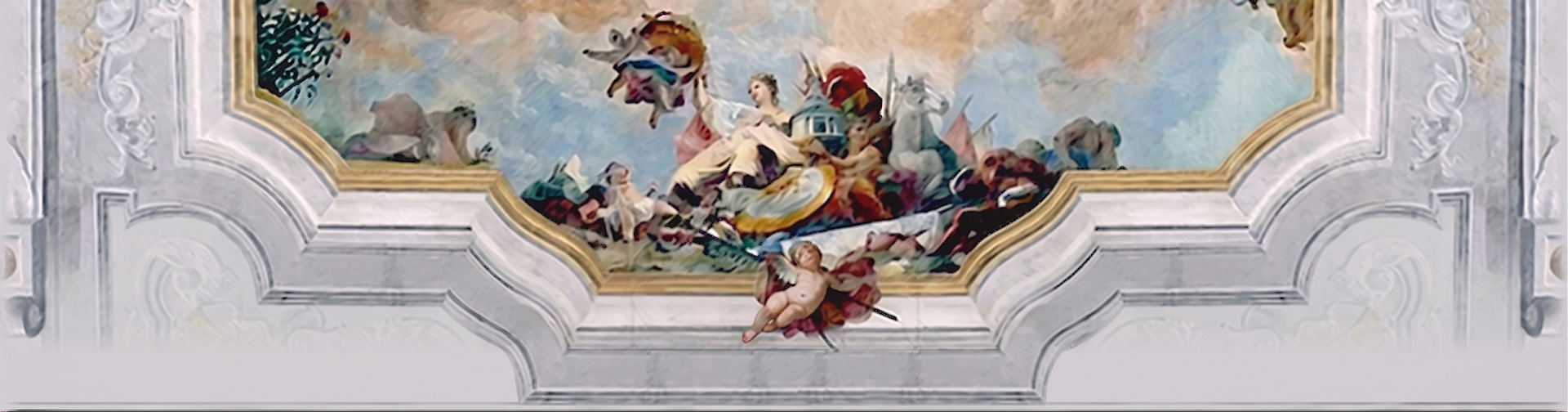
Where the destinies of the city are guided today as they were in the past, we dedicate ourselves to the fine arts this weekend. The historical town hall conceals a small jewel within: a hall with a perfectly formed Rococo stucco ceiling. This filigree craftsmanship breathes the spirit of bygone days and provides the most authentic setting conceivable for our preparation. Large windows facing the Baroque town center flood the parquet with daylight, creating an atmosphere that effortlessly unites concentration and dignity. During the intervals, the Café im Paradeis tempts just next door. This is the true charm of such a fine Baroque town: everything lies within a comfortable walking distance.
IV. The Art of Dancing:
From Practice to Grace
When it comes to imparting these dances, I certainly challenge you during the instruction. We refine figures, spatial paths, and steps intensively until they become second nature to you. This may appear strict at times, but it has a highly appealing reason: only those who have mastered the technique almost in their sleep can radiate that carefree lightness and elegance demanded by our epoch on the evening of the ball. The concentrated work of the day is the foundation for the effortless play of the night.
V. Understanding the Whence and Why
It does not suffice for me merely to dictate sequences of steps to you. I wish to fathom the whence and why together with you. We derive our posture directly from the fascinating history of the eighteenth century and observe the subtle social rules of play at court and in urban societies.
A minuet or a contredanse was never merely a pastime during the zenith of the Rococo. It was a precise reflection of the hierarchy, an eloquent yet silent conversation and – not least – the most subtle instrument of gallant approach. He who understands this and allows it to flow into his movements does not simply execute steps. He brings history to life.
VI. True Tact and the Courage to Connect
A final secret of this art is the sense of tact – in its most beautiful, dual sense of the word. I expect absolute respect for the music, a precise listening, and the rhythmic merging with the masterful compositions. However, the sensitive, courteous interaction upon the dance floor is equally imperative to me.
A historical dance is not an isolated solo. It is a fleeting, shared moment of togetherness. Lift your gaze from the floor. Dare to truly look your counterpart in the eyes and bestow a sincere smile. Only when we permit this genuine connection and shed modern shyness does the Rococo unfold its full, pulsating charm.